
El Salvador Travel Guide: Suchitoto and El Cuco for First-Time Visitors
- May 9, 2025
- 15 min read
Updated: 1 hour ago
El Salvador was one of those countries that quietly surprised me.
After exploring Honduras, our Central America journey continued with a brief return to Guatemala before crossing into El Salvador. It was a short visit, but it gave me two very different sides of the country: the colonial charm of Suchitoto and the slow coastal calm of El Cuco.
El Salvador is the smallest country in Central America, but it does not feel small when you are actually there. It has colonial towns, lakes, volcanoes, beaches, food traditions, art, history, and a warmth that slowly reveals itself when you stop rushing.
For this part of the trip, I traveled with Intrepid Travel, which made the border logistics, transportation, and itinerary easier to manage. As a Philippine passport holder, I am always more cautious with border crossings and entry requirements, especially when traveling across multiple countries in Central America.
This El Salvador travel guide is based on my personal experience visiting Suchitoto and El Cuco, with practical tips for first-time visitors who want culture, food, local crafts, and a relaxing beach escape.
Why Visit El Salvador?
El Salvador is often overlooked by travelers moving through Central America, but that is exactly why it felt interesting to me. It did not feel over-commercialized. It felt local, honest, and still full of places waiting to be appreciated.
If you are planning a Central America itinerary, El Salvador is worth considering because it offers:
Beautiful colonial towns like Suchitoto
Traditional food experiences such as pupusa making
Indigo dyeing workshops and local artisan culture
Peaceful lakeside views at Lago Suchitlán
Pacific beaches like El Cuco
A more relaxed, less crowded travel experience
Easy connections to Guatemala, Honduras, and Nicaragua
For me, El Salvador was not about rushing through a checklist. It was about slowing down, learning something local, eating something handmade, and ending the day by the ocean.
About El Salvador
Before visiting El Salvador, it helps to know a few practical details, especially if you are including it as part of a longer Central America itinerary.
Capital: San Salvador
Currency: United States Dollar
Language: Spanish
Best time to visit: November to April, during the dry season
Main international airport: El Salvador International Airport, also known as San Óscar Arnulfo Romero International Airport
Power plug: Type A and Type B
Time zone: Central Standard Time
Known for: Pupusas, volcanoes, Pacific beaches, colonial towns, surfing, coffee, and warm local culture
El Salvador is the smallest country in Central America, but it offers a surprisingly varied travel experience. You can explore colonial towns like Suchitoto, visit lakes and volcanoes, join cultural workshops, relax on Pacific beaches, and continue easily toward Guatemala, Honduras, or Nicaragua.
For Philippine passport holders and other travelers moving through Central America, always check updated visa and entry requirements before your trip. Border rules, documents, and onward travel requirements can change, especially if you are traveling overland.
Also, bring some cash for small towns, prepare basic Spanish phrases, stay connected with an eSIM, and consider travel insurance for peace of mind while moving between destinations.
My El Salvador Route at a Glance
My route was simple:
Honduras → Guatemala → El Salvador → Nicaragua
Inside El Salvador, we visited:
Suchitoto → El Cuco
This route worked well because Suchitoto gave us culture, history, and colonial charm, while El Cuco gave us rest after days of moving across Central America.
If you only have a short time in El Salvador, this combination is a good introduction to the country.
Why I Visited Suchitoto Instead of San Salvador
For this El Salvador trip, I visited Suchitoto instead of San Salvador because it was part of our organized group tour route through Central America.
At first, I did not know much about Suchitoto. Like many first-time visitors, I probably would have expected San Salvador to be the main stop because it is the capital city. But traveling with a tour group sometimes brings you to places you might not have chosen on your own — and Suchitoto became one of those quiet surprises.
Suchitoto gave me a slower and more cultural introduction to El Salvador. Instead of spending most of our time in a busy capital, we stayed in a peaceful colonial town with cobblestone streets, local workshops, lake views, and a very relaxed atmosphere.
Looking back, I actually appreciated that the tour included Suchitoto. It allowed me to experience a more intimate side of El Salvador — making pupusas, learning about indigo dyeing, walking around the town square, and seeing how much character a small place can hold.
That does not mean San Salvador is not worth visiting. If you have extra time, you can still add San Salvador as a day trip from Suchitoto or as a practical stop before continuing your route. But for this journey, Suchitoto gave me a gentler and more memorable first impression of El Salvador.
How to Get to Suchitoto
Suchitoto is one of the easiest cultural towns to add to an El Salvador itinerary, especially if you are coming from San Salvador or traveling through Central America.
Most travelers reach Suchitoto by private transfer, rental car, shuttle, organized tour, or public bus from San Salvador. If you are arriving by air, the most practical route is usually:
San Salvador International Airport → San Salvador → Suchitoto
If you are traveling overland like I did, Suchitoto can also fit naturally into a longer Central America route after visiting Guatemala or Honduras.
For me, arriving in Suchitoto felt like a change of pace after days of movement. The town was quieter, slower, and more charming than I expected — the kind of place where you do not need to rush your first afternoon.
Can You Visit San Salvador from Suchitoto?
Yes. San Salvador is close enough to visit from Suchitoto as a day trip or as a practical transfer stop before continuing to another part of El Salvador. If you want to add museums, historic plazas, restaurants, or more transport options, San Salvador can easily fit into your route.
For this itinerary, I would still keep Suchitoto as the main cultural base. It feels more peaceful, more walkable, and more memorable if you want colonial charm, local workshops, lake views, and a slower travel experience.
How Many Days Do You Need in El Salvador?
For this specific route, I would recommend at least 5 to 6 days.
A good short itinerary would look like this:
Day 1: Arrive in Suchitoto, explore the town, central park, Santa Lucía Church, and Lago Suchitlán viewpoint
Day 2: Pupusa-making class, indigo dyeing workshop, local art, and cultural stops
Day 3: Travel to El Cuco, relax by the beach, stay overnight
Day 4-5:Enjoy the beach
Day 6: Continue onward to Nicaragua or another destination
If you want to explore more of El Salvador, you could add San Salvador, Ruta de las Flores, Santa Ana Volcano, Lake Coatepeque, or El Tunco.
Where to Stay in Suchitoto
In Suchitoto, we stayed at Hotel Jardín de las Marias, located close to the central square.
This was one of those hotels that fit the mood of the town perfectly. It had a peaceful garden setting, a swimming pool, rustic charm, and a two-level open-air dining area where you could relax and listen to the birds.
After several travel days, it felt good to stay somewhere quiet. Suchitoto is the kind of place where you do not need a big hotel experience. You just need a comfortable base where you can walk to the main square, rest in the afternoon, and feel the slow rhythm of the town.
Best area to stay in Suchitoto:
Stay close to the central square or within walking distance of Santa Lucía Church. This makes it easier to explore the town without needing extra transportation.
Things to Do in Suchitoto
Suchitoto was my favorite cultural stop in El Salvador. It felt peaceful, artistic, and full of small details — cobblestone streets, colonial buildings, murals, lake views, and quiet corners where you can simply sit and watch the town move around you.
1. Walk Around Central Park and Santa Lucía Church
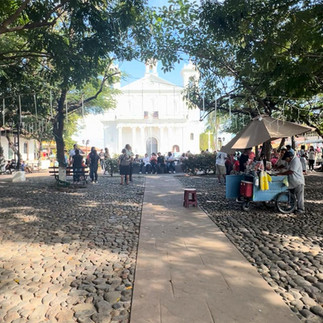
The best way to start your visit is around Parque Central and Iglesia Santa Lucía.
This area is the heart of Suchitoto. You will see locals gathering, food stalls, small shops, and the white colonial church facing the square. It is not a place you need to rush. Walk slowly, take photos, try some snacks, and let the town introduce itself naturally.
We also saw small town tour rides available for around $3, which can be a simple way to get a quick introduction to the area.
From the town center, you can also head toward the Mirador de Suchitoto for views of Lago Suchitlán, one of the most scenic parts of the area.



2. Take a Pupusa-Making Class
One of the most memorable experiences I had in El Salvador was learning how to make pupusas.
Pupusas are El Salvador’s national dish — thick handmade corn tortillas usually filled with cheese, beans, chicharrón, or a mix of ingredients. They are simple, filling, and deeply connected to Salvadoran food culture.
We joined a pupusa-making class at La Posada de Suchitlán, and what made the experience even better was the view. Making pupusas while overlooking the lake gave the activity a different feeling. It was not just about food. It felt like learning a small piece of the country through your hands.
This is the kind of experience I would recommend to any first-time visitor because it is interactive, affordable, and meaningful.

3. Try an Indigo Dyeing Workshop at Arte Añil
Another highlight of Suchitoto was our indigo dyeing workshop at Arte Añil, located near the main square.
Before this trip, I did not fully understand how important indigo was to Salvadoran history and traditional craft. During the workshop, we learned how indigo leaves are transformed into natural dye and used to create beautiful patterns on fabric.
What I liked about this experience was that it supported local artisans and helped preserve a traditional craft. It was hands-on, creative, and more meaningful than simply buying a souvenir.
By the end of the workshop, you do not just leave with a dyed piece of fabric. You leave with a better appreciation of the people keeping this tradition alive.





4. Visit Centro Arte Para la Paz
If you want to understand more about Suchitoto’s history and community spirit, visit Centro Arte Para la Paz.
The center is located in a former convent and focuses on peace, education, art, and local transformation
.
Suchitoto has a complex history connected to El Salvador’s civil war, and places like this help visitors understand how art and community work became part of healing and rebuilding.
It is a quiet but meaningful stop, especially if you enjoy culture, history, and local stories.
5. See Cascada Los Tercios
Just outside Suchitoto, you can visit Cascada Los Tercios, a seasonal waterfall known for its unusual volcanic rock formations.
The waterfall flows over hexagonal basalt columns, which makes it visually different from a typical waterfall. Depending on the season, the water level may vary, but even when it is dry, the rock formation itself is still interesting to see.
This is a short visit and a good add-on if you have extra time in Suchitoto.
6. Explore Local Art, Murals, and Artisan Shops
Suchitoto has a creative atmosphere. As you walk around town, you will find murals, galleries, handmade crafts, textiles, jewelry, and small shops filled with local character.
This is one of the best things to do in Suchitoto if you enjoy slow travel. Instead of only visiting attractions, give yourself time to wander. Sometimes the best part of a colonial town is not the official stop — it is the quiet street, the painted wall, the small shop, or the conversation you did not expect.
7. Take a Boat Ride on Lago Suchitlán
If you have enough time, consider taking a boat ride on Lago Suchitlán.
The lake gives you a different perspective of Suchitoto and the surrounding landscape. Some tours may include birdwatching, especially around areas like Isla de los Pájaros, where you may see herons, pelicans, and other birdlife.
Even if you do not take a boat ride, try to at least enjoy the lake view from one of the town’s viewpoints or restaurants.
8. Take a Day Trip to San Salvador
If you have extra time in Suchitoto, you can also visit San Salvador as a day trip. The capital is close enough to add to your itinerary, especially if you want a short city experience before continuing your El Salvador route.
San Salvador gives you a different side of the country compared to Suchitoto. While Suchitoto feels quiet, colonial, and artistic, San Salvador is busier, more urban, and better for museums, restaurants, historic plazas, and transport connections.
You can visit places like the historic center, the Metropolitan Cathedral, Plaza Libertad, the National Palace, or one of the city’s museums if you want to understand more of El Salvador beyond its small towns and beaches.
For this route, I would still treat San Salvador as an optional add-on rather than the main focus. Suchitoto is the place to slow down, walk around, join local workshops, and enjoy the colonial charm, while San Salvador works better as a short side trip or practical connection point.
Travel Tip: Plan Your Route Before You Go
El Salvador looks small on the map, but travel days can still feel long when you are moving between countries, especially in Central America.
Because our journey involved Honduras, Guatemala, El Salvador, and Nicaragua, the route planning mattered. You need to think about transportation, border crossings, overnight stops, and how much energy you realistically have between destinations.
El Cuco: A Peaceful Beach Escape in El Salvador
After exploring Suchitoto, we traveled southeast to El Cuco, a small beach town on El Salvador’s Pacific coast.
This part of the trip felt completely different. Suchitoto was cultural and colorful. El Cuco was slow, open, and calming.
After days of movement, borders, towns, workshops, and group travel, El Cuco felt like a pause. It was the kind of place where you could walk barefoot, listen to the waves, and let your body catch up with the journey.
Where We Stayed in El Cuco
In El Cuco, we stayed at La Tortuga Verde, a beachfront eco-lodge.
The location was the best part. The beach was just steps away, and the property had hammocks, open-air spaces, a relaxed atmosphere, and a sea turtle conservation connection.
It was not a luxury resort, but it had the kind of simple coastal feeling that matched the place. Sometimes, when you are traveling long-term or moving through several countries, what you really need is not luxury. You need a hammock, ocean air, and a quiet place to reset.


Things to Do in El Cuco
El Cuco is not a destination where you need a packed itinerary. The point of going there is to slow down.
1. Walk Along the Beach
The beach was the main experience for me.
Long walks, ocean air, and quiet moments made El Cuco feel like a reward after the cultural stops and travel days. It is a good place to swim, rest, watch the sunrise, or simply do nothing for a while.

2. Walk to El Cuco Town
We walked to El Cuco town, which was about 5 km one way from where we stayed.
It was a simple walk, but it gave us a better feel for the area. We explored the town, tried local food at a small family-run restaurant, and then walked back along the beach during sunset.
That sunset walk became one of the quiet memories of the trip. Not dramatic, not planned, but peaceful.
3. Ask About Boat Tours or Coastal Trips
If you want to explore more, ask your accommodation about boat rides, nearby beaches, estuaries, or other coastal activities.
El Cuco is more relaxed than some of El Salvador’s famous surf towns, so it is better for travelers who want a quieter beach experience rather than nightlife or a busy backpacker scene.
Practical Travel Tips for El Salvador
Check Entry Requirements Before Traveling
Entry rules can change, especially depending on your passport, visa history, and whether you are entering by land or air. As a Philippine passport holder, I always check visa and border requirements before moving between countries.
This is especially important in Central America because one trip may involve several countries and multiple border crossings.
Avoid Rushing Your Itinerary
Even though El Salvador is small, do not treat it like a country you can fully understand in one day. If you only have limited time, choose a few meaningful stops instead of trying to see everything.
Suchitoto and El Cuco worked well together because they gave me two different moods: culture and coast.
Bring Cash
Small towns, local restaurants, workshops, and transportation may not always be card-friendly. Bring enough cash for meals, tips, small purchases, and local experiences.
Stay Connected
Having internet access helps a lot when navigating, checking transport details, contacting accommodations, translating Spanish, or coordinating border crossings.
Be Mindful of Safety
El Salvador has changed a lot in recent years, but travelers should still use common sense. Avoid unnecessary night travel between cities, use reliable transportation, keep valuables low-key, and ask locals or your accommodation for current advice.
I felt fine during my visit, but I also traveled with an organized group, which made logistics easier.
Learn a Few Spanish Phrases
Spanish is very useful in El Salvador, especially in smaller towns like Suchitoto and El Cuco. Even basic phrases can make interactions smoother and more respectful.
Useful Travel Tools Before Visiting El Salvador
For a trip like this, especially if you are crossing Central America, these are the things I would prepare:
Offline maps
Translation app
eSIM or local SIM
Travel insurance
Visa and entry requirement checker
Copies of passport and important documents
Small cash
Lightweight day bag
Comfortable walking shoes
Sunscreen and insect repellent
Best Time to Visit El Salvador
The best time to visit El Salvador is generally during the dry season, from November to April, when the weather is better for walking, sightseeing, beaches, and outdoor activities.
The rainy season can still be beautiful, but you may need more flexibility, especially if visiting waterfalls, rural roads, or coastal areas.
Is El Salvador Worth Visiting?
Yes, El Salvador is worth visiting, especially if you enjoy destinations that feel less crowded and more local.
For me, El Salvador was not about big famous landmarks. It was about the small moments: making pupusas with a lake view, learning indigo dyeing from local artisans, walking through Suchitoto’s quiet streets, resting in a garden hotel, and ending the journey by the beach in El Cuco.
It is a country that rewards travelers who slow down.
Suggested Short El Salvador Itinerary: Suchitoto and El Cuco
Day 1: Arrive in Suchitoto
Spend your first day walking around the central square, visiting Santa Lucía Church, exploring local streets, and enjoying the view of Lago Suchitlán.
Stay overnight in Suchitoto.
Day 2: Culture, Food, and Local Crafts
Take a pupusa-making class, join an indigo dyeing workshop, visit Centro Arte Para la Paz, and explore local galleries or murals.
Stay another night in Suchitoto.
Day 3: Travel to El Cuco
Head to the coast and check in at a beachfront stay like La Tortuga Verde. Spend the afternoon walking along the beach, swimming, or relaxing in a hammock.
Stay overnight in El Cuco.
Day 4: Beach Morning and Continue Onward
Enjoy a slow morning by the ocean before continuing your journey to Nicaragua, San Salvador, or another part of El Salvador.
Final Thoughts on Visiting El Salvador
El Salvador was a short chapter in my Central America journey, but it left a gentle impression on me.
Suchitoto showed me the country’s artistic and cultural side. El Cuco gave me the space to slow down by the Pacific coast. Together, they created a simple but meaningful route — one that balanced learning, food, history, local craft, and rest.
Sometimes the best travel memories are not the loudest ones. They are the quiet ones: sitting in a garden hotel after a long travel day, shaping a pupusa with your hands, watching indigo dye spread across fabric, or walking back from a small beach town as the sun lowers over the ocean.
El Salvador deserves more attention from travelers exploring Central America. It may be small, but it carries a lot of soul.
FAQs About Visiting Suchitoto and El Cuco
Is Suchitoto worth visiting?
Yes, Suchitoto is worth visiting if you enjoy colonial towns, local culture, art, history, lake views, and slower travel. It is one of the best cultural stops in El Salvador.
How many days should I spend in Suchitoto?
One to two days is enough for most travelers. With two days, you can explore the town, take a pupusa-making class, try an indigo workshop, visit local art spaces, and enjoy Lago Suchitlán.
Is El Cuco worth visiting?
Yes, El Cuco is worth visiting if you want a quiet beach escape in El Salvador. It is better for relaxation than nightlife, making it a good stop after busy travel days.
What is El Salvador known for?
El Salvador is known for pupusas, volcanoes, Pacific beaches, surfing, colonial towns, lakes, coffee, and warm local culture.
Can you visit El Salvador as part of a Central America trip?
Yes. El Salvador fits well into a Central America route with Guatemala, Honduras, and Nicaragua. Many travelers visit it as part of a longer overland journey.
What should I not miss in Suchitoto?
Do not miss Santa Lucía Church, the central square, Lago Suchitlán views, a pupusa-making experience, an indigo dyeing workshop, and the local artisan shops.




Comments